To Fibrus or Not to Fibrus?
That is the question
I have been with BT Broadband for many years, since the mid-2000s, and it has always been my go-to internet provider.
From the mid-2000s, the speed was 512 Kbps (0.5 Mbps) when the broadband service was first launched, a huge upgrade from the dial-up speed of 56 Kbps, and with each improved broadband technology that came, it went to around 2,048 Kbps (2 Mbps) and eventually settled at 3.5 Mbps, which was the maximum speed my line could have on the most days via the copper lines 2.5 miles down the road from the Moneymore exchange, although I found out in the later years that my lines do not go along the road to the exchange but rather go the other road in a different direction, which is longer!
My nature of work is IT and webdesign so to get around it, I had to get a 2nd broadband line in late 2015, also from BT, to cope with the household demand (streaming, WhatsApp video calls, etc.) and for use with my work solely.
However, even with two lines, it was getting a bit long in the tooth in the early 2020s so one of my neighbours and I were discussing the other viable options, such as Starlink, satellite, rural Wi-Fi link and mobile broadband. Anything faster than what is currently possible with copper-line broadband would be worthwhile. Not only that, standard broadband prices were rising, which was not helpful, pushing my payment to BT from £50ish a month to well over £60 in total for two 3.5 Mbps lines.
Fibrus

My neighbour mentioned Fibrus, which was very new at that time and I was sceptical of Fibrus, as a couple of new up-and-coming broadband providers claimed ridiculous speeds in rural areas, only to turn out to be either slow or unreliable. She said she was going to sign up for that, and in the meantime, I was already a few months into a two-year contract with BT.
A few months later, I was getting frustrated with my broadband connections, as one of my lines had been doing poorly for at least a couple of months after a big storm, with no sign of improvement even after going back and forth with BT support and engineers’ visits, and out of curiosity, for the sake of finding a faster connection, I texted my neighbour to see whether she had signed up with Fibrus.
She sent me a picture of her Fibrus internet status from the eero router app showing a jaw-dropping speed of over 300 Mbps! Just above their advertised 300 Mbps at that time. Not only that but also uploads of over 100 Mbps! These were what I would call ridiculous speeds; it was just unimaginable in this quite remote location, close to the foot of Slieve Gallion mountain, next to Carndaisy Wood.
I had no choice but to order the Fibrus 300 Mbps package (now upgraded to the 500 Mbps package) even though they offer an insane 1 Gbps (1,000 Mbps) package coupled with their even more powerful eero Wi-Fi routers, apparently to cope with full-speed fibre connections. Not only that, Fibrus offers to pay off your existing contract (terminated) up to a certain amount, which made my decision easier.
It took Fibrus a few weeks to come around to installing the optic broadband and once it got connected, I got an almost 100x speed increase over the old BT broadband, going from averaging 3-3.5 Mbps to 300 Mbps! That was an insane upgrade which I thought was impossible just a few months before.
All of a sudden, the download times for updating apps on the mobile devices, tablets and computers have been cut to just mere seconds, if not a minute and the installation times for apps take longer than the time it took to download them! That is normal, given the hardware limitations of the devices, speed of flash storage, Wi-Fi technologies, etc., but that showcases how blazing fast the Fibrus connection really is.
With the new fibre connection installed, I was able to get rid of all the old copper wiring and sockets in my hall and study room, and now a fibre modem (ONT) is tucked away nicely in a corner behind the TV stand and well out of sight.
To check the availability of Fibrus and the best speed in your area, you need to enter your postcode at https://fibrus.com/availability/.
Fibre Technologies – FTTC vs FTTP
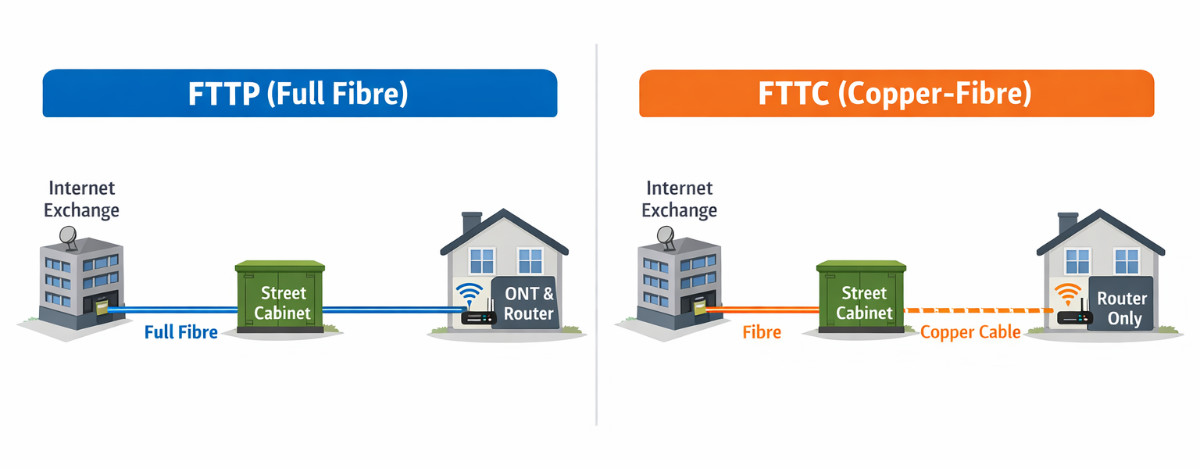
Unlike the major broadband providers in the rural areas, especially in Northern Ireland, Fibrus does a full FTTP (Fibre To The Premises), which means a 100% fibre optic cable all the way to your house, without the use of old copper wires.
FTTC (Fibre To The Cabinet) on the other hand, is slower, generally capping at 80 Mbps, although it can be a lot lower in real life (35-68 Mbps), as it uses older copper wires for the final connection to your house from the street cabinet.
Hence the word ‘Cabinet’ rather than ‘Premises’ (e.g., your home or business property) – because FTTC optical fibre stops at the street cabinet rather than going all the way to your house. FTTC upload speeds are also limited to up to 20 Mbps.
Another term for FTTP is ‘Full Fibre’, while FTTC is often referred to as ‘Copper‑Fibre’.
At the time of writing this (March 2026), it’s well over 3 and a half years after I signed up to Fibrus’ FTTP connection. The BT is only able to offer an inferior FTTC connection to my property at the average speed of 30 Mbps at a whopping £75.48 a month (from March 2027 at £79.48/month)!.
Whereas I’m only paying Fibrus a discount of £34.99 for 500 Mbps, which I renewed and upgraded last September. Not only that but Fibrus also offers premium, superior-performance Eero routers over BT’s proprietary Smart Hub 2.
There is absolutely no contest at all when it comes to considering the fibre optic connection, the performance of routers and the pricing. Highly recommended!